
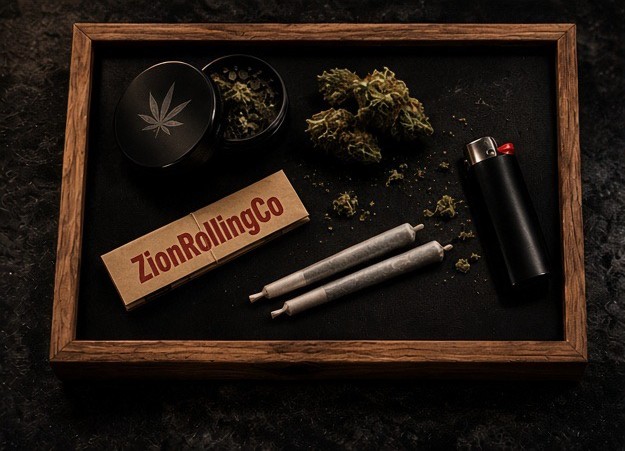
Anyone can rush a roll. It takes a little more patience, and the right surface, to make one that actually looks and holds together the way it should. None of this is complicated, but it is easy to skip when you're doing it on a shifting lap or a cluttered counter.
Start with an even grind
An uneven grind is the single most common reason a roll ends up lumpy or loose in the middle. Take the extra few seconds to check for pockets of coarse or fine material before you start, and spread it evenly rather than piling it in one spot.
Work on a flat, still surface
A wobbly magazine or a shifting lap fights you the entire time. A flat tray solves this instantly, it doesn't slide, it doesn't tip, and it gives you a fixed edge to pack against. This is the whole reason a dedicated surface earns its place, not the papers or the grinder, just a still, flat plane to work on.
Pack from the ends in
Rather than packing straight down the middle, work the material toward each end first, then fill the center last. This keeps the roll from bulging in one place and thinning in another, and it makes for a far more even burn.
Roll slow, tuck once
The tuck is the part people rush most, and it's the part that determines whether the whole thing holds its shape. Roll it back and forth a few times to firm it up before you tuck, then tuck once with even pressure instead of adjusting it repeatedly.
The surface makes the habit
None of these habits require anything special, but they're a lot easier to build when you have a dedicated space that invites you to slow down instead of rushing through it on whatever flat thing is nearby. That's the quiet argument for a real tray: not that it does the rolling for you, but that it makes doing it well the easy option.